kb-retriever
此技能是一个面向本地知识库的智能检索与问答助手。它通过分层索引导航,并针对PDF/Excel等文件类型,强制要求先学习处理方法再进行渐进式检索,避免整文件加载。通过结合grep、Read、pdfplumber、pandas等工具,高效地从知识库中提取信息,回答用户关于资料查询、信息检索等问题。
npx skills add https://github.com/conardli/garden-skills --skill kb-retrieverBefore / After 效果对比
1 组在大型本地知识库中手动查找特定信息,或使用简单的全文搜索,往往耗时费力,尤其面对PDF和Excel等复杂格式时,容易遗漏关键数据或等待漫长的文件加载。
通过分层索引和渐进式检索,AI能快速定位并提取所需信息,针对PDF/Excel等文件类型智能处理,大幅缩短信息查找时间,提高准确性。
本地知识库检索 Skill(kb-retriever)
知识库目录说明
- 知识库存放在一个根目录下,包含多种文件类型(如
.md/.txt、.pdf、.xlsx等),通常按类型或业务用途拆分为多级子目录。 - 采用分层目录索引文件:
- 根目录有一个
data_structure.md,说明主要的「领域目录」及其用途。 - 每个领域目录下可以有自己的
data_structure.md,说明该目录下有哪些子目录/文件,以及各自用途。 - 更深一层的子目录也可以继续有
data_structure.md,形成多级索引树。
- 根目录有一个
- 知识库根目录约定:
- 默认认为知识库位于当前项目根目录下的
knowledge/目录。 - 如果用户在对话中明确指定了其他路径(例如“我的知识库在 /data/kb”或“用 ./docs 这个目录作为知识库”),则以用户指定的路径作为根目录。
- 当默认路径
knowledge/不存在或访问失败时,应向用户确认实际的知识库根目录位置,而不是随意猜测。
- 默认认为知识库位于当前项目根目录下的
- 单个业务文件可能很大:
- 不要直接用 Read 读取整文件
- 对 PDF、Excel 使用对应 Skill 进行结构化处理后,再结合 grep/局部读取做精细检索
定位 knowledge 根目录
- 根目录优先听用户:如果用户给了路径(如
./docs、./knowledge-personal),直接用用户提供的路径。 - 默认根目录:否则约定根目录为当前项目下的
knowledge/。- 使用 shell 显式检查目录是否存在:优先使用
test -d knowledge,或退而求其次使用ls -d knowledge。 - 注意:禁止使用
Glob "knowledge" in .这类模式来判断目录是否存在,Glob只返回文件路径,不返回目录本身,空结果并不能区分“目录不存在”和“目录存在但为空”。
- 使用 shell 显式检查目录是否存在:优先使用
- 只有在根目录已通过
test -d等方式确认存在时,才使用 Glob 在该目录下检索内容,并把目录作为path,例如:- 索引文件:
pattern="**/data_structure.md",path="knowledge" - 所有 Markdown:
pattern="**/*.md",path="knowledge"
- 索引文件:
- 如果默认
knowledge/不存在(test -d失败):不要猜测其他目录,明确告诉用户未找到默认根目录,并让用户指定实际知识库路径。
关键原则:先学习,再处理
遇到 PDF 或 Excel 文件时的强制检查清单:
- ✅ 已读取对应的 references 文档学习处理方法
- ✅ 已理解推荐的工具和命令
- ✅ 已将文件处理(提取/转换)完成
- ⏭️ 现在可以开始检索
禁止行为:
- ❌ 在未读取 pdf_reading.md 的情况下直接尝试处理 PDF
- ❌ 在未读取 excel_reading.md 的情况下直接尝试处理 Excel
- ❌ 跳过文件处理步骤,直接对原始 PDF/Excel 进行检索
总体流程
-
理解用户需求
- 读用户问题,提取:
- 主题/领域关键词(如“销售报表”“系统架构”“接口文档”)
- 时间或范围限定(如“2023 年 Q1”“最近版本”)
- 需要的输出类型(解释、摘要、具体字段数值等)
- 确定知识库根目录:
- 优先检查用户是否在问题中指定了知识库路径。
- 否则使用默认根目录
knowledge/。 - 若默认根目录不存在或目录结构异常,应向用户询问确认,而不是自行假设。
- 读用户问题,提取:
-
分层查看目录索引
data_structure.md- 使用一个「当前工作目录」的概念:
- 默认从用户指定的知识库根目录开始;如果用户未指定,则使用当前目录。
- 在当前工作目录下,如果存在
data_structure.md:- 使用 Read 读取该文件的前若干行(例如 limit=300),必要时分段继续读取。
- 目标:
- 了解当前目录下有哪些子目录和文件
- 理解每个子目录/文件的用途说明
- 基于用户问题,挑选最相关的若干个子目录或文件,构成候选集合。
- 对于候选子目录:
- 递归进入该子目录,将其作为新的「当前工作目录」,继续查找其中的
data_structure.md并重复上述过程。 - 在递归过程中,避免一次性深入所有分支,优先沿着与问题最相关的路径向下钻取。
- 递归进入该子目录,将其作为新的「当前工作目录」,继续查找其中的
- 对于候选业务文件(md/文本、PDF、Excel 等):
- 在完成必要的目录层级探索后,收集这些文件为最终的检索目标列表。
- 在优先级排序时:
- 优先选择用途说明与问题主题高度匹配的领域目录和文件
- 其次考虑时间/版本等约束(如果索引中有体现)
- 通用说明类文档(如 README.md、总体设计类文档)放在较后优先级
- 使用一个「当前工作目录」的概念:
-
学习文件处理方法(遇到 PDF/Excel 时强制执行)
- 在处理 PDF 文件前:
- 必须先读取 references/pdf_reading.md(注意这个目录位于 Skills 目录下,而不是 Knowledge 目录下)学习提取方法
- 重点了解:pdftotext 命令、pdfplumber 用法、表格提取方法
- 在处理 Excel 文件前:
- 必须先读取 references/excel_reading.md学习读取方法
- 必须先读取 references/excel_analysis.md学习分析方法
- 重点了解:pandas 读取、列筛选、数据过滤
- 目的:确保使用正确的工具和方法,避免盲目检索
- 在处理 PDF 文件前:
-
按文件类型执行处理和检索
- 使用刚学到的方法处理文件(提取、转换、结构化)
- 对每类候选文件,按照下面「Markdown/文本」「PDF」「Excel」策略执行
- 总原则:
- 优先从最相关、最精确的文件开始
- 每个文件内都渐进式地局部检索,避免一次性加载全内容
- 若当前文件得不到满意信息,切换到下一个候选文件
-
迭代检索
- 所有文件类型都使用统一的「多轮迭代检索机制」(见上文公共检索原则)
-
答案组织与溯源
- 汇总多轮检索得到的上下文,综合回答用户问题。
- 尽量:
- 给出清晰、直接的回答
- 指出使用过的文件名(必要时包含大致位置,如章节或大概行数/页数)
- 如果答案基于推断或信息不完全:
- 明确标注假设与不确定性
- 提示用户可以补充更具体的文件范围或关键词
公共检索原则
关键词选择策略
- 从用户问题提取 3-8 个关键词(含可能的英文缩写、同义词、上位/下位词)
- 可组合词组(如 "销售 报表"、"API 接口 超时")
- 必要时包含业务词、技术术语、常见缩写(如 "uv"、"pv"、"GMV")
grep 检索基本原则
- 始终指定尽量精准的 include 和 path,避免搜索整个目录
- pattern 优先尝试问题中的核心名词、术语,再尝试同义词
- 对于每个命中,只读取匹配附近的局部区域(上下若干行)
- 保存「文件名 + 位置信息 + 文本片段」
多轮迭代检索机制(最多 5 次)
所有文件类型都采用统一的迭代策略:
- 迭代控制
- 维护「已尝试检索次数」计数,最多 5 次
- 每次检索后累加计数
- 每轮迭代流程
- 基于问题生成/更新检索关键词(可包括同义词、扩展词)
- 选择尚未充分检索的文件或文件部分
- 执行检索(grep/局部读取/专用 Skill 调用)
- 分析获取的上下文片段
- 判断是否足够回答问题
- 终止条件
- 找到足够支撑回答的上下文;或
- 已达到 5 次尝试仍未找到合适信息
- 信息不足时的处理
- 明确告知用户信息缺失或可能不在当前知识库中
- 提供已找到的最接近信息,并说明不确定性
- 提示用户可以如何缩小范围(更具体的文件名、关键词、时间范围等)
注意事项
- 禁止第一次就直接调用:
Glob "knowledge" in .或任何试图用 Glob 判定目录存在性的调用,目录存在性应通过 shell 命令(如test -d)检查。 - 使用本 Skill 查询知识库时,禁止使用网络搜索等其他工具获取知识
针对不同文件类型的具体策略
1. Markdown / 文本类文件(.md, .txt, .log 等)
-
候选文件选择
- 根据
data_structure.md和文件名、路径判断相关度 - 优先检索标题和目录类文件(如汇总文档、设计总览)
- 根据
-
grep 定位与局部读取
- 使用 Grep 工具对指定候选文件,include 限定具体后缀(如 "*.md")
- 对于有匹配的文件,使用 Read 仅读取匹配附近的局部区域:
- 通过行号偏移和 limit 控制读取(例如从匹配行附近往前后各读取几十行)
- 避免整文件读取
-
特殊处理
- 如内容仅是目录/标题,根据链接或小节名继续定位深入内容
- 应用「多轮迭代检索机制」(见上文公共检索原则)
2. PDF 文件检索策略
工作流:
-
首先:读取处理方法指南
- 在处理任何 PDF 之前,必须先读取 references/pdf_reading.md(注意这个目录位于 Skills 目录下,而不是 Knowledge 目录下)
- 重点了解:pdftotext 命令、pdfplumber 用法、表格提取方法、快速决策表
-
选择候选 PDF
- 根据
data_structure.md中的描述,选择最相关的 1-3 个文件 - 如果用户指明具体 PDF 文件,则优先使用该文件
- 根据
-
应用学到的方法提取文本
- 使用 pdf_reading.md 中推荐的工具(优先 pdftotext 或 pdfplumber)
- 重要:使用
pdftotext input.pdf output.txt将文本提取到文件,不要直接输出到 stdout(避免占用大量 token) - 如需提取表格,使用 pdfplumber 的表格提取功能
-
对提取结果执行检索
- 使用 grep 对提取的文本进行关键词搜索
- 对于每个命中,提取命中附近范围的上下文(上下数十行或相邻几页)
- 保存「文件名 + 页码/大致位置 + 文本片段」
- 应用「多轮迭代检索机制」(见上文公共检索原则)
3. Excel 文件检索策略
工作流:
-
首先:读取处理方法指南
- 在处理任何 Excel 之前,必须先读取:
- references/excel_reading.md - 学习如何读取工作表(注意这个目录位于 Skills 目录下,而不是 Knowledge 目录下)
- references/excel_analysis.md - 学习如何分析数据(注意这个目录位于 Skills 目录下,而不是 Knowledge 目录下)
- 重点了解:pandas 读取方法、列筛选、数据过滤、聚合操作
- 在处理任何 Excel 之前,必须先读取:
-
选择候选 Excel
- 根据
data_structure.md和文件/工作表命名,选择最相关的表 - 优先选择包含「报表」「统计」「日志」「配置」「映射」等关键词的工作簿/工作表
- 若用户指明具体 Excel 文件,优先使用该文件
- 根据
-
应用学到的方法探索结构
- 使用 pandas 读取前 10-50 行(使用
nrows参数限制) - 重点掌握:列名/字段名、数据类型(数值、日期、文本)、关键字段
- 将列名与用户问题比对,识别潜在关键字段(如「收入」「销售额」「error_code」等)
- 使用 pandas 读取前 10-50 行(使用
-
执行数据检索和分析
- 使用学到的 pandas 方法进行过滤和聚合(如
df[df['column'] == value]) - 每次只读取匹配行附近的数据,避免一次性读取整表
- 如问题包含时间范围,在检索中加入时间过滤
- 应用「多轮迭代检索机制」(见上文公共检索原则)
- 使用学到的 pandas 方法进行过滤和聚合(如
与其他工具的协同
PDF 处理
- 在处理 PDF 前必须先读取 references/pdf_reading.md 学习处理方法
- 使用 pdfplumber/pypdf 进行文本提取、表格提取、元数据读取
- 优先使用 pdftotext 命令行工具进行快速文本提取
Excel 处理
- 在处理 Excel 前必须先读取:
- references/excel_reading.md - 学习读取方法
- references/excel_analysis.md - 学习分析方法
- 使用 pandas 进行数据探索、预览、过滤和分析
工具使用原则
- Grep:用于按关键词在指定文件中查找行号与匹配片段,始终指定尽量精准的 include 和 path
- Read:只用于局部读取文件,始终设置合理的 limit(如 200-500 行)和合适的偏移
- 对于任何可能很大的文件:
- 禁止直接从头读到尾
- 始终先通过索引、目录、关键词等方式缩小范围后再读
回答风格与错误处理
- 回答风格
- 尽量用用户提问的语言(中文/英文)作答。
- 先给出结论,再给出简要依据。
- 如需要,可在后面列出引用的文件和大致位置,例如:
- 来源:design/api_gateway.md 第 100 行附近
- 来源:reports/2023_Q1_sales.xlsx Summary 工作表
- 信息缺失或不确定时
- 明确说明在当前知识库中没有找到完全匹配的信息或只能部分回答。
- 不臆造事实。
- 提示用户可以如何帮助缩小范围:
- 指定更具体的目录/文件
- 提供更精确的关键词或字段名
- 指定时间/版本范围
Kb Retriever Skill — Local Knowledge-Base Retriever
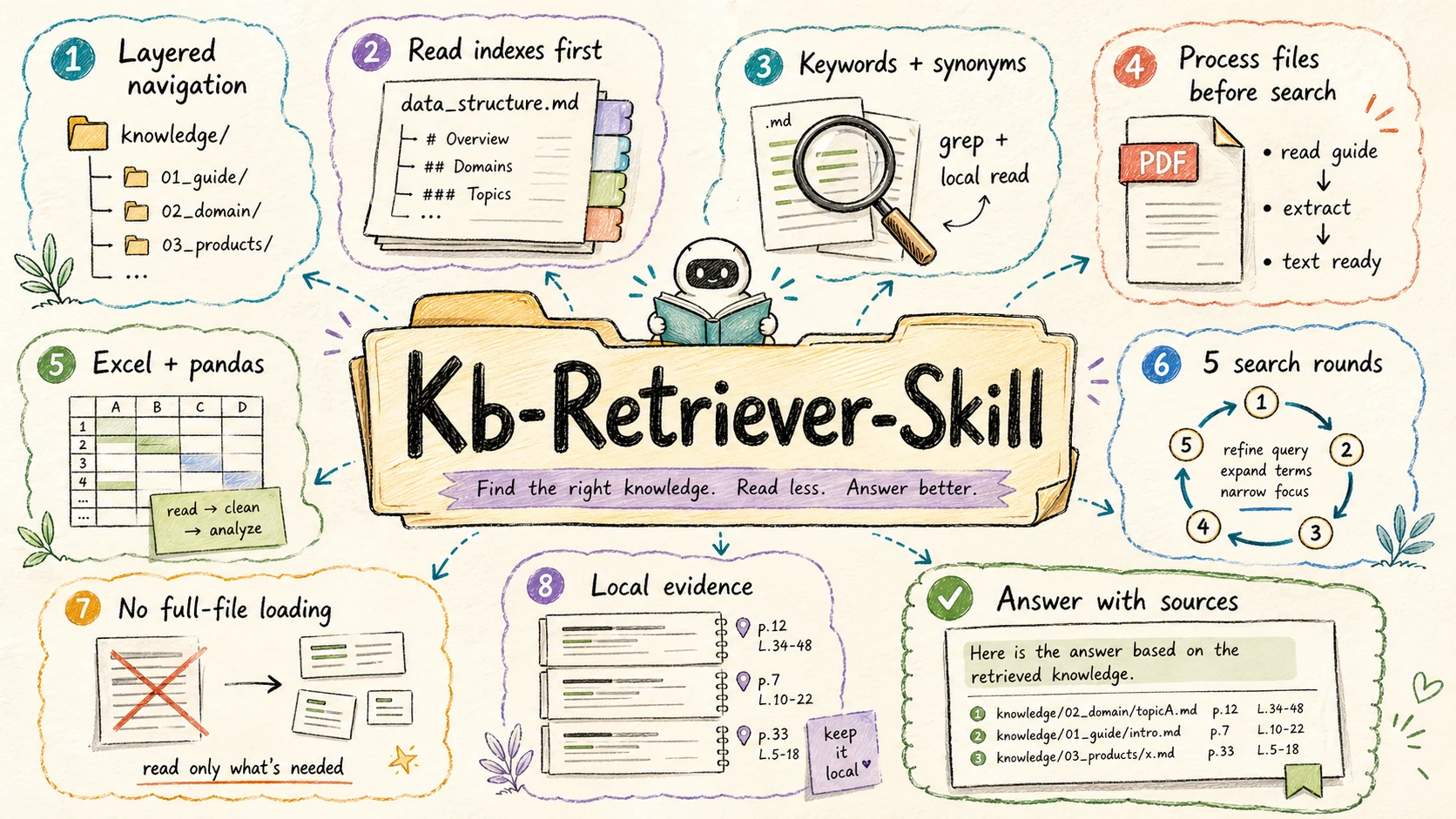
A skill for AI agents to efficiently answer questions over a local, multi-format knowledge directory using hierarchical index navigation and progressive retrieval — without ever loading whole files into context.
中文文档 · Back to collection root
What it does
Point the agent at a local directory full of mixed-format files (Markdown, PDF, Excel, …) and ask questions in natural language. The skill:
- Walks a hierarchical index of
data_structure.mdfiles to figure out which files are likely to contain the answer. - Forces a learn-before-process step when it hits a PDF or Excel — it must read the corresponding
references/*.mdfirst and use the recommended tool, instead of blindly reading the whole file. - Retrieves progressively with
grep+ small windowed reads (offset/limit) instead of dumping entire files into context. - Iterates up to 5 rounds, narrowing keywords each round until it has enough evidence to answer.
Core features
- ✅ Multi-format: Markdown / text, PDF, Excel — extensible per file type.
- ✅ Hierarchical index: each directory carries its own
data_structure.md, forming an index tree the agent navigates. - ✅ Progressive retrieval: grep-first, windowed reads, never whole-file loads — keeps token usage low even on large corpora.
- ✅ Mandatory learning step: PDF/Excel processing is gated on reading the right
references/*.mdfirst. - ✅ Bounded iteration: at most 5 retrieval rounds, with explicit termination conditions.
Skill structure
skills/kb-retriever/
├── SKILL.md                            Main skill (frontmatter name: kb-retriever)
├── README.md  /  README.zh-CN.md       This document
├── references/
│   ├── pdf_reading.md                  How to handle PDFs (pdftotext / pdfplumber / pypdf)
│   ├── excel_reading.md                How to read Excel with pandas (nrows, dtype, etc.)
│   └── excel_analysis.md               How to filter / aggregate / derive metrics on Excel
└── scripts/
    └── convert_pdf_to_images.py        Convert PDF pages to images when text extraction fails
Setting up your knowledge base
This skill does not ship a knowledge base — you bring your own. Two ways to wire it up:
Default location
Put a knowledge/ directory at the root of the workspace where you invoke the agent:
your-project/
├── .claude/skills/  or  .agents/skills/
│   └── kb-retriever/             ← this skill folder
└── knowledge/                    ← ← ← your knowledge base
    ├── data_structure.md         (root-level index, see template below)
    ├── <domain-1>/
    │   ├── data_structure.md
    │   └── ...
    └── <domain-2>/
        └── ...
Custom location
Tell the agent which path to use in your question, e.g. "answer from ./docs" or "my knowledge base is at /data/kb". The skill will use that path instead.
If the default knowledge/ does not exist and the user hasn't specified a path, the skill will ask rather than guess.
data_structure.md template
Each indexed directory should carry one of these:
# [Directory name]

## Purpose
What this directory is for and when it should be searched.

## Files
- file1.pdf — what it contains, time / version range
- file2.xlsx — schema summary, key columns
- subdir/ — what lives in this subdirectory

## Coverage
Time range, version, source, anything else that helps the agent prioritize.
How it retrieves
1. Hierarchical index navigation
For each directory level the skill reads data_structure.md, picks the most relevant child(ren) for the user's question, and recurses — so it doesn't fan out across the whole tree.
2. Learn before process (PDF / Excel)
When the candidate set contains a PDF or Excel file, the skill must first read the corresponding reference doc:
✅ Read references/pdf_reading.md  /  excel_reading.md  /  excel_analysis.md
✅ Understand the recommended tool & flags
✅ Convert / extract the file with that tool
⏭️  Then start retrieving
Forbidden:
- ❌ Trying to process a PDF without reading
pdf_reading.md - ❌ Trying to process an Excel without reading
excel_reading.md/excel_analysis.md - ❌ Skipping the conversion step and grepping the raw binary
3. Progressive retrieval
- Don't read whole files.
- Use
grepto locate keywords first. - Read only the matching window (
limit≈ 200–500 lines). - Iterate up to 5 rounds, refining keywords.
4. Per-format tool strategy
| Format | Tool | Notes |
|---|---|---|
| Markdown / text | grep + windowed read_file | Always offset/limit; never whole-file. |
pdftotext input.pdf output.txt → grep on the text | Always extract to a file, never to stdout. Use -f / -l for page ranges on huge PDFs. | |
| Excel | pandas with nrows first to learn schema, then filtered reads | Identify key columns (id / time / category) before querying. |
5. Iteration loop
Each round:
- Generate / update keywords
- Pick under-explored candidate files
- Run grep / windowed reads
- Inspect snippets
- Decide: enough to answer? → stop. Otherwise iterate.
Stops on either: answer found ✅, or 5 rounds reached ⏱️.
Best practices
Recommended
- Always start from
data_structure.md. - Read the matching
references/*.mdbefore touching a PDF or Excel. - Retrieve from the most relevant file first; expand only if needed.
- Use
offset+limitto read precise windows. - Extract PDFs to files, then grep — never paste the binary into context.
Avoid
- ❌ Reading entire large files in one go.
- ❌ Processing PDF / Excel without reading the references first.
- ❌
pdftotext input.pdf -(stdout) — eats tokens. - ❌ Loading a whole Excel sheet at once.
- ❌ Blind search across all directories.
FAQ
Q1: Why force the agent to read references/*.md first?
To make sure the agent uses the right tool with the right flags — otherwise it tends to either dump huge files into context or pick a slow / broken tool.
Q2: How do I handle a very large PDF?
Use page-ranged extraction (pdftotext -f 1 -l 10), grep the resulting text, then read only the matching pages.
Q3: Can my knowledge base live anywhere?
Yes. Just say so in your question: "answer from /data/my-kb".
Q4: How do I improve retrieval accuracy? Use specific keywords, narrow down with time / file-name hints, and prefer domain-specific terminology over generic words.
Tool requirements
The skill assumes the agent has access to:
grep— text searchread_file— windowed reads with offset / limitpdftotext(poppler) orpdfplumber— PDF text extractionpandas— Excel reads & analysis
scripts/convert_pdf_to_images.py is provided for the fallback case where text extraction yields nothing useful (scanned PDFs).
License
MIT
用户评价 (0)
发表评价
暂无评价
统计数据
用户评分
为此 Skill 评分